

From Writing Code to Orchestrating Execution
How Architecture Enables AI-Scale Productivity

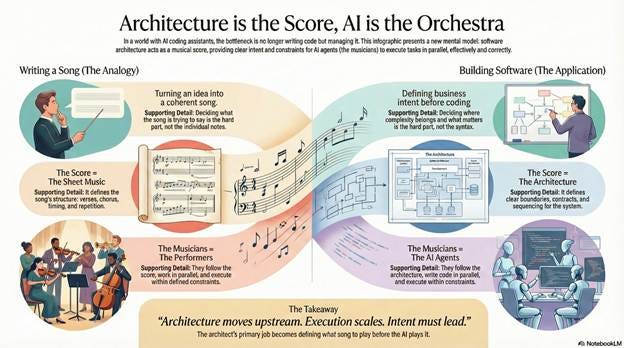
In the traditional software development model, the primary bottleneck has often been the speed at which a human can write code. However, the industry is currently undergoing a fundamental shift: the challenge is no longer how to write code faster, but how to manage an electronic partner effectively.
This new paradigm treats software development not as a manual construction project, but as a masterpiece of orchestration. When we shift our focus from line-by-line coding to high-level intent, we unlock a level of productivity that was previously impossible.
The Process: Architecture as the Orchestral Score
To understand this new way of working, consider the analogy of writing a song. The most difficult part of songwriting isn’t the physical act of writing notes; it is deciding what the song is trying to say and where the attention belongs.
In this model, Architecture is the score. It is written before the code and consists of:
Defining Intent: Clearly deciding what the software is meant to accomplish.
Setting Boundaries: Establishing clear contracts and sequencing for the work.
Managing Complexity: Deciding where complexity belongs and where work remains routine.
Once this “score” is clearly defined, the actual execution—the “verses and chorus”—follows naturally. AI agents act as the musicians, executing their specific parts within the constraints provided by the architect.
The Exponential Impact on Speed and Productivity
The reason this method leads to exponential gains is that it enables parallel execution across multiple agents (when done correctly). Unlike traditional development, which is often linear, this model allows for massive scaling of execution.
Scaling Execution, Not Just Labour: Because AI agents work in parallel within defined constraints, the volume of usable code produced increases significantly.
Moving Architecture Upstream: By moving the architectural phase “upstream,” the focus shifts to guiding execution before testing even begins. This reduces the risk of producing “plausible noise” and ensures the output is functional and coherent.
Focusing on the Result, Not the Goal: The architect focuses on the high-level business problem, allowing domain rules, edge cases, and persistence to follow as a result of the clear intent.
A New Role for the Developer
This shift is not about replacing developers; it is about elevating them. The developer’s role is evolving into that of a conductor or architect, ensuring the “musicians” (the AI agents) play in harmony. By clearly defining the intent and constraints, the developer ensures the final “song”—the software—is exactly what the business needs.
In this new era, intent must lead because execution scales. The faster we can define the score, the faster the orchestra can play.