

To Use AI Well, Start Before the Software
The real opportunity is not making software smarter. It is understanding customer intent earlier.

Most organizations are asking the wrong AI question.
They ask:
How do we add AI to email?
How do we add AI to CRM?
How do we add AI to support tickets?
How do we add AI to the call center?
Those questions start too late.
They begin after the company has already forced the customer’s intent into a product, channel, workflow, queue, or department.
That is downstream thinking.
To use AI well, start before the software.
Start before the inbox.
Start before the ticket.
Start before the call center.
Start before the CRM.
Start before the application decides what the customer means.
The real question is much simpler:
When a customer has a thought, what happens next?
That is where loyalty starts.
A customer thinks:
I have a question.
I need help.
I want to buy something.
I need to change something.
Something isn’t working.
Something doesn’t feel right.
At that moment, the company either becomes easier to trust or easier to replace.
The customer should not have to learn the company’s organizational chart.
They should not have to understand which department owns their problem.
They should not have to decide whether their issue belongs in sales, support, operations, billing, product management, or legal.
They have intent.
The company should be ready to receive it.
Most companies have forgotten this.
They view customer contact as cost.
Cost becomes something to reduce.
The result is predictable.
More forms.
More queues.
More knowledge bases.
More ticket numbers.
More chatbots.
More deflection.
More friction.
The company believes it has become more efficient.
The customer feels the company has become harder to reach.
AI should not make that problem worse.
AI should not become a more sophisticated wall between the customer and the company.
AI should help organizations understand intent earlier.
Not after the customer has entered the maze.
Before the maze exists.
The only company I have found that seems to understand this is FreshBooks.
Here is why.
Their support experience does not feel like deflection.
It does not start with:
Search the knowledge base.
Open a ticket.
Talk to a bot.
Wait for a response.
Choose the correct department.
Prove your issue matters.
FreshBooks gives you two clear options:
Ask or call. We are here.
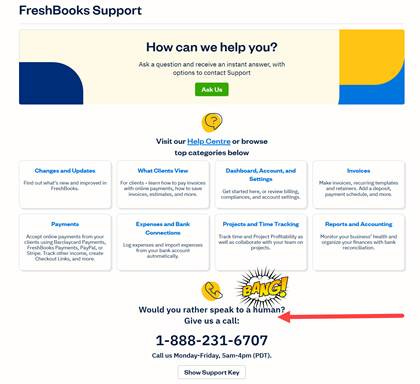
That sounds simple.
It is not.
It signals how the company thinks about the customer.
A call is not treated as an interruption.
A call is not buried behind reception.
A call is not treated as support’s problem.
A call is treated as important to the company.
That is why I am loyal.
Not because FreshBooks has accounting software.
Many companies have accounting software.
I am loyal because when I have a thought, a question, or a problem, I trust they are ready to receive it.
That is the point most companies miss.
The customer’s intent does not begin when a ticket gets created.
It does not begin when an email lands in an inbox.
It does not begin when a call enters a queue.
It begins when the customer has a thought and knows it.
At that moment, the company either earns trust or loses it.
FreshBooks earns it because they make the next step obvious.
Ask.
Call.
We are here.
This is where I believe AI has the potential to change business.
Not by making existing software smarter.
Not by helping employees work through tickets faster.
Not by generating better responses after a problem has already occurred.
The opportunity is much earlier.
The opportunity is to create an intent layer.
A layer that helps organizations detect, understand, route, and learn from customer intent before it becomes trapped inside departments, workflows, and software applications.
The customer does not think in departments.
The customer does not think in workflows.
The customer does not think in terms of tickets.
The customer thinks in outcomes.
That distinction matters.
Consider the airline industry.
An airline believes it sells seats.
The customer believes they purchased transportation.
The customer wants to travel from one place to another with reasonable comfort, safety, timing, cost, and dignity.
When an airline designs a seat with inadequate legroom, the company often treats the issue as a capacity, revenue, or product decision.
The customer sees something different.
The customer sees a company that forgot human beings have legs.
That is not a seat problem.
That is an intent problem.
The company optimized around its internal view of the world.
The customer judged the experience based on the outcome they were seeking.
By the time a complaint arrives, the company is already far downstream from the original intent.
Support hears the complaint.
Product reviews the feature.
Finance reviews the numbers.
Operations reviews capacity.
Marketing reviews loyalty.
The customer wonders how nobody noticed the obvious.
AI gives organizations an opportunity to move upstream.
To pay attention sooner.
To recognize intent before it becomes frustration.
To recognize patterns before they become complaints.
To understand customers before they become tickets.
The companies that win with AI will not necessarily be the companies with the most AI features.
They will be the companies that listen earlier.
The companies that move closer to the moment a customer has a thought.
The companies that make it easy to express that thought.
The companies that treat customer intent as a signal for the entire organization, not a problem to be routed into a queue.
That is where the real AI opportunity begins.
Before the software.